It is critical to begin planning for replacement of hardware, software, and services that use public-key algorithms now.

NIST
On ECC for encryption and digital signatures
Quorum lets classical and quantum-resistant signers coexist in the same Solana multisig. Require post-quantum approval from day one, or migrate gradually from today’s signing schemes without changing your multisig address.
It is critical to begin planning for replacement of hardware, software, and services that use public-key algorithms now.
A one-in-seven chance that some fundamental public-key cryptography tools will be broken by 2026. 50% chance by 2031.

There's a 50/50 chance quantum computers will be powerful enough within five years to break the cryptographic protections. We should migrate to a quantum-resistant signature scheme.

Elliptic curves are going to die sooner than many assume — possibly before 2028.

Working independently, both Anza and Firedancer arrived at the same conclusion: the need for a post-quantum digital signature scheme with compact signatures.

Cryptographically relevant quantum computers are likely still several years away, but Solana should not wait for Q-day to begin preparing.

The key is to be on this journey today and not wait until the last minute.
It is critical to begin planning for replacement of hardware, software, and services that use public-key algorithms now.
A one-in-seven chance that some fundamental public-key cryptography tools will be broken by 2026. 50% chance by 2031.
There's a 50/50 chance quantum computers will be powerful enough within five years to break the cryptographic protections. We should migrate to a quantum-resistant signature scheme.
Elliptic curves are going to die sooner than many assume — possibly before 2028.
Working independently, both Anza and Firedancer arrived at the same conclusion: the need for a post-quantum digital signature scheme with compact signatures.
Cryptographically relevant quantum computers are likely still several years away, but Solana should not wait for Q-day to begin preparing.
The key is to be on this journey today and not wait until the last minute.
Solana accounts, multisigs, and signed transactions rely on elliptic-curve cryptography. A sufficiently capable quantum computer can derive a private key from an exposed public key, breaking that security model entirely.
Quorum supports both paths. Teams ready to adopt post-quantum signing can create multisigs that require Falcon or Winternitz approval from day one. Teams that need continuity can begin with existing Ed25519 or Secp256k1 signers, add post-quantum members when ready, and increase post-quantum approval requirements over time without changing the multisig address.
Create a Quorum multisig with today’s signers, post-quantum signers, or both. The multisig address is stable from the beginning, so future signer changes do not require moving assets or updating authority references.
Add post-quantum members immediately, or when operationally ready. Falcon-512 gives a compact NIST-selected lattice path aligned with Solana’s direction of travel. Winternitz gives a conservative hash-based path for teams that want a different security assumption.
In addition to the core approval threshold, Quorum can require a minimum number of post-quantum approvals. For example, a 3-of-5 multisig can require 3 approvals total, including at least 1 Falcon or Winternitz approval.
As the quantum threat heightens, rotate classical approvers into lower-trust roles, or out of the approval path entirely. Existing assets, vault addresses, proposal history, and governance references remain continuous.
Quorum supports classical and post-quantum signing schemes in the same multisig. Each scheme has different compatibility, security assumptions, compute costs, signature sizes, and operational trade-offs.
Flows and features to serve a range of use-cases
Quorum includes the workflows teams already expect from a serious multisig platform: proposals, voting, execution, member rotation, permissions, asset management, time-locks, and on-chain auditability. The difference is that these workflows work across classical and post-quantum signers.
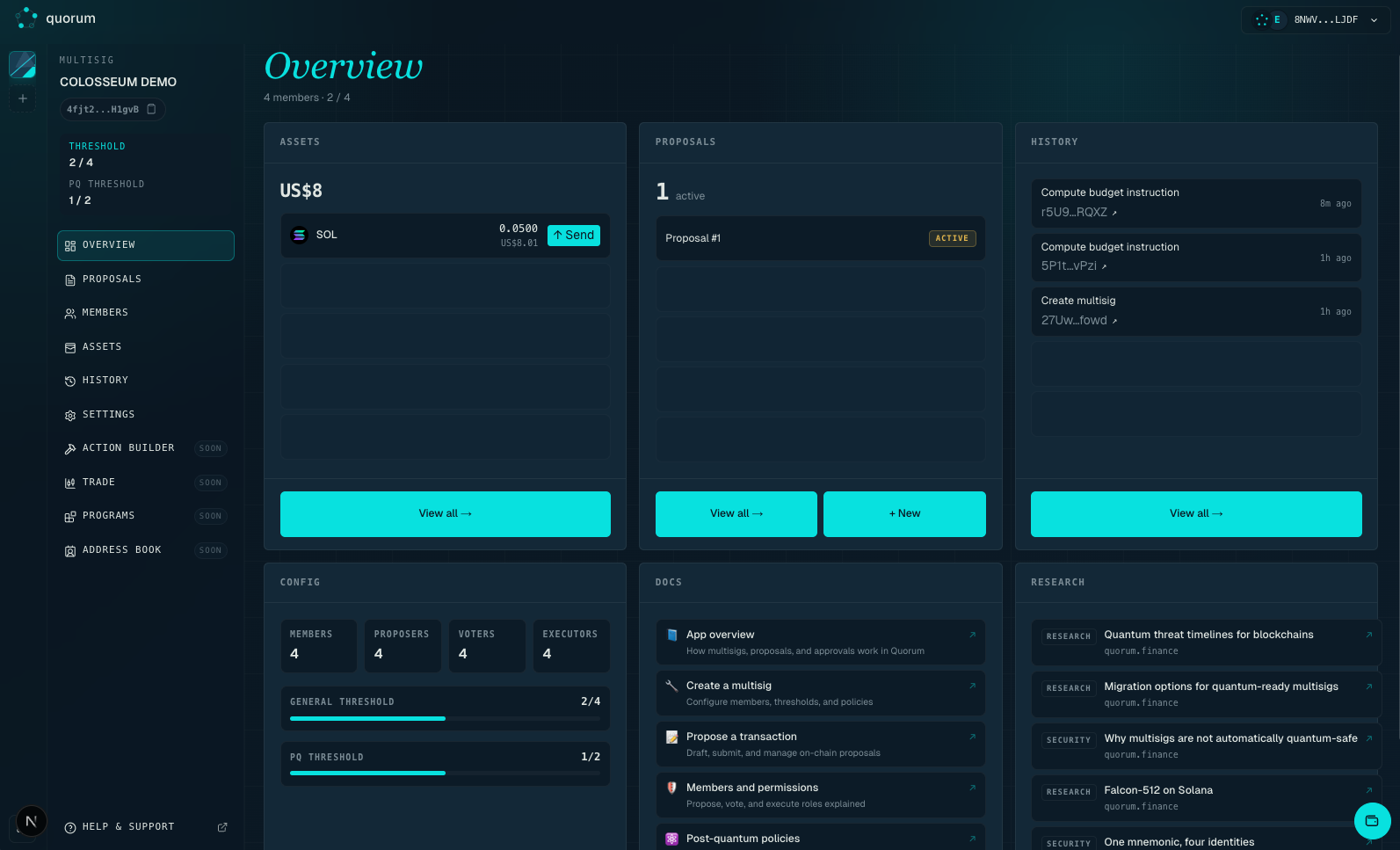
Create treasury transfers, program actions, and settings changes as governed proposals. Members approve with Ed25519, Secp256k1, Falcon-512, or Winternitz signatures.
Add all supported member types to the same multisig. Rotate identities without changing the multisig address.
Set a standard threshold and require one or more post-quantum approvals for sensitive actions.
Upgrade members from classical to post-quantum identities over time while keeping the same vault address and proposal history.
Add a delay between approval and execution for treasury movements, upgrades, and admin actions.
Votes, settings changes, and executions are recorded on-chain for review, reporting, and incident response.
View balances, propose transfers, and govern treasury operations from the same multisig surface.
Assign members roles such as proposer, voter, executor, or settings authority.
quantum ready wallet
The Quorum wallet supports the signer types needed for mixed classical and post-quantum multisigs. It lets users switch between Solana, EVM, Falcon, and Winternitz wallets, create post-quantum wallets on-chain, and approve Quorum proposals without leaving the browser.
Approve proposal and settings actions from the browser plugin.
Solana, EVM, Falcon, and Winternitz wallets from one seed.
Generate and create Falcon and Winternitz wallets on-chain for devnet testing.
One seed can derive supported wallet types through domain-separated branches.
Propose arbitrary dApp transactions to a Quorum multisig.
Use post-quantum accounts outside multisig approval flows.
Support hardware-backed approval paths as firmware support matures.
App-native signing experiences using the same wallet core.
Use Quorum through TypeScript and Rust SDKs, canonical signing preimages, registered signer identities, and programmatic transaction builders.
Create a multisig, register signers, propose, vote, and execute.
Manage Quorum identities, recovery, registration, and signing.
Compare Ed25519, Secp256k1, Falcon-512, and Winternitz.
Understand separate derivation branches and root mnemonic risk.
01Go deeper on the threat timeline, migration paths, Solana decisions, and the signing schemes behind Quorum.
Keep the short answers honest: Quorum is quantum-ready infrastructure, not a promise that every key or chain is already quantum-proof.
Try Quorum on devnet, read the docs, and test post-quantum signing flows before mainnet readiness.